
Criminal Court Cases in Brown County
Brown County divides criminal court cases by jurisdiction. Felonies are filed through the District Clerk for the 35th District Court. Most Class A and Class B misdemeanors go to County Court at Law. A local rule sends theft-by-check cases to the constitutional County Court, while municipal and justice courts keep their own fine-only matters. The filed charge level, incident location, and issuing agency are useful clues when a cause number is unknown.
The clerk, not the prosecutor or jail, maintains the court file. District Clerk records are in Room 216 of the Brown County Courthouse, while the County Clerk is in Room 101. The four Brown County justice courts have separate jurisdiction over fine-only offenses and magistrate work. A single name search cannot reliably cover all these records.
The official justice-court page shows the local structure. View the Brown County justice courts source before contacting a precinct.
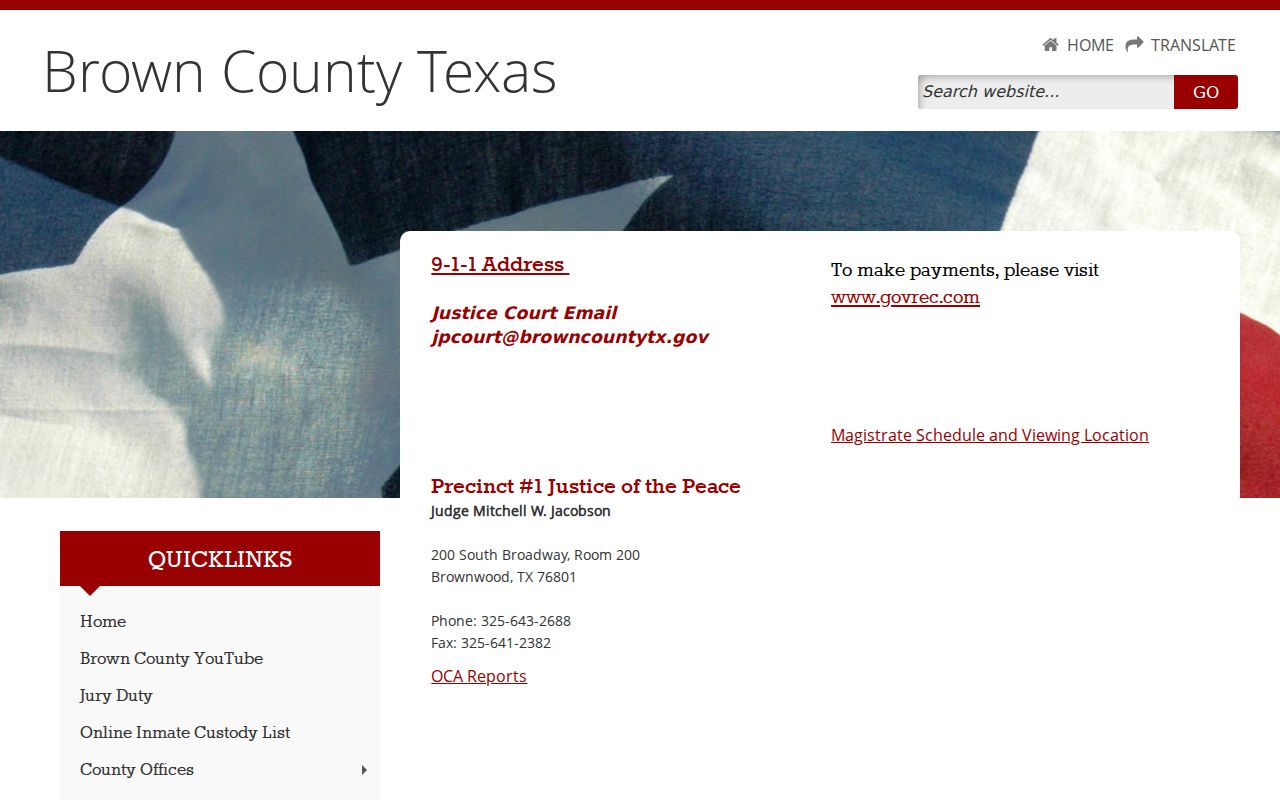
Its shared contacts help route fine-only records that will not appear in a felony file.
Felony Files in Suite 216
The Brown County District Clerk is the direct custodian for filed felony cases. The criminal section is at 200 South Broadway Street, Room 216, Brownwood, and may be reached at 325-646-5514, Monday through Friday from 8:00 a.m. to 5:00 p.m. Give the clerk the defendant name, cause number if known, and an approximate filing year. Ask whether the file can be inspected electronically, at the counter, or through a copy request.
A plain copy is suitable for reading. A certified copy bears the clerk's authentication and may be needed for a formal filing or agency correction. Confirm current fees before ordering. The District Clerk page is the best starting point.
The source page identifies the public felony-record office.

This office, not the District Attorney's restricted discovery portal, answers public file requests.
Brown County Case Record Searches
Start locally, then use re:SearchTX as a supplement. Statewide coverage, documents, registration, and charges vary by participating court. An absent result does not prove that Brown County lacks a case, especially for an older file or a lower court without a full online index.
- Classify the accusation as felony, county misdemeanor, city Class C, or justice-court matter.
- Review local dockets to identify a court and hearing date.
- Call the correct clerk with the name, cause number, and filing year.
- Use re:SearchTX to check participating courts and note its limits.
- Order plain or certified documents and read each count's disposition.
| Field Label | Type | Required | Notes |
|---|---|---|---|
| Search Type | Select | Portal dependent | Choose the available person or case search. |
| Search | Text | Yes | Enter a party name or known cause number. |
| Court / County | Filter | No | Select Brown or a known court when available. |
| Date Range | Date | No | Narrow by the likely filing period. |
| Case Type | Filter | No | Limit results to a criminal category. |
The portal image documents this statewide search. Open the official re:SearchTX source to confirm current controls.
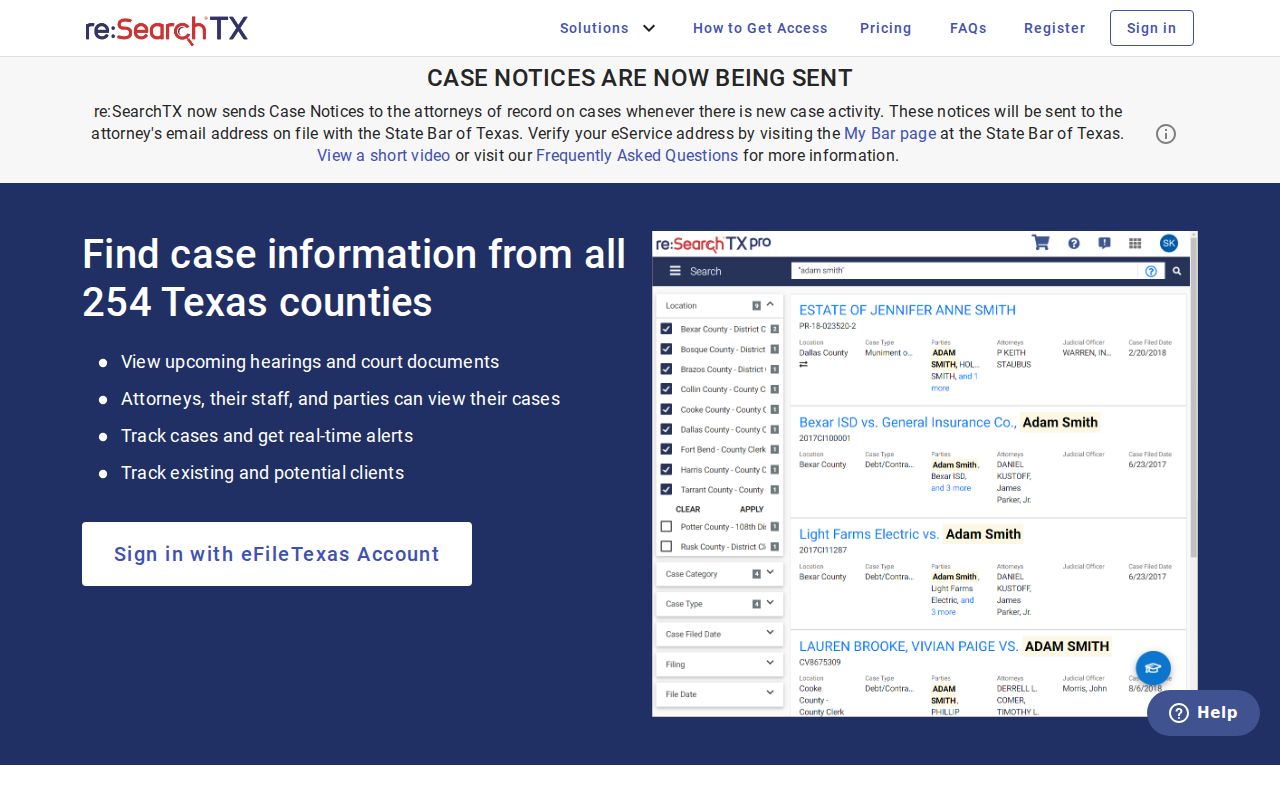
Compare every portal hit with the clerk's docket and case file.
Brown County Weekly Criminal Dockets
The County Court at Law page preserves dated criminal docket PDFs across multiple years. These are useful snapshots when a reader knows a hearing week. They are not a comprehensive name-indexed database, and they may not include later orders or the final outcome.
County Court at Law sits in Room 208 and lists 325-646-5859. Most Class A and B misdemeanor cases run through this court. For an old case missing online, ask the County Clerk for an archive search.
The official archive provides the current docket set.
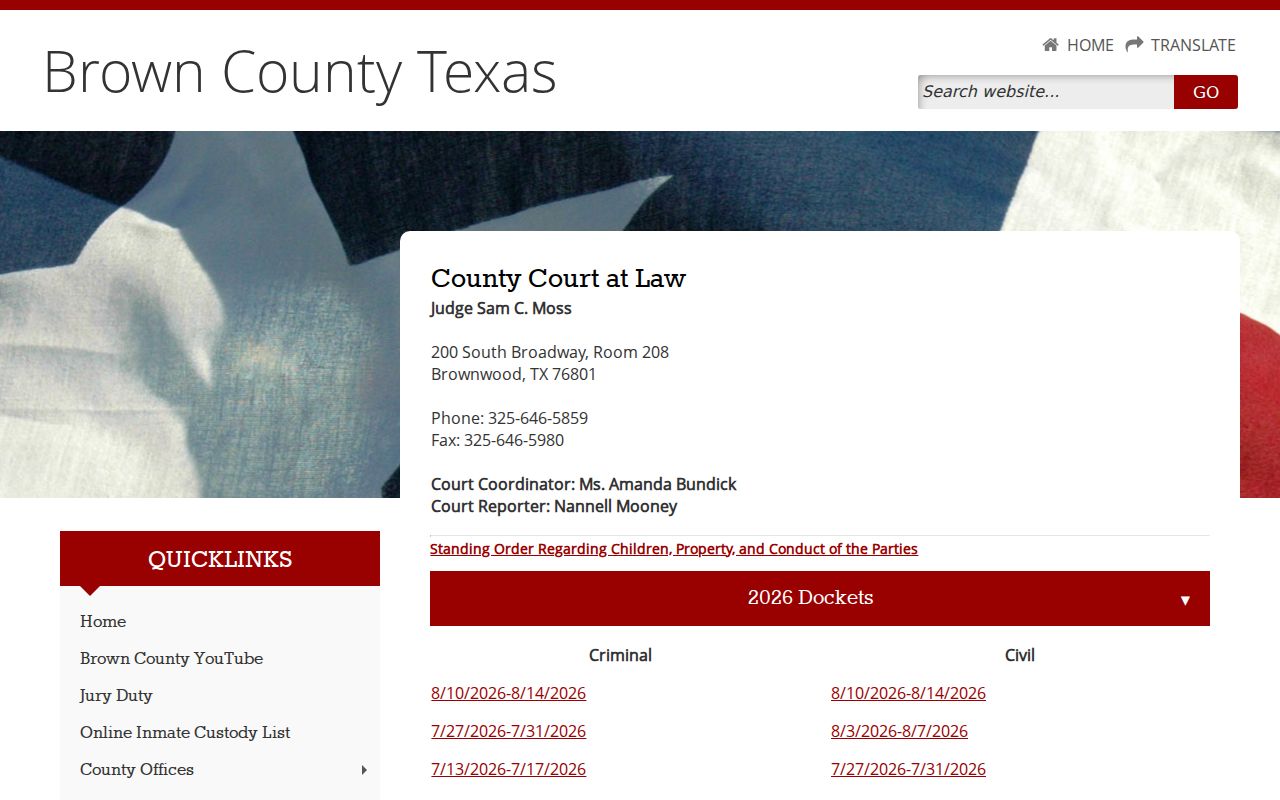
Docket dates narrow a request, but only the clerk's file supplies the complete record.
What a Criminal Case File Contains
A Brown County case file follows the filed prosecution, not merely the allegation at booking. It can show who filed the charge, how each count changed, what the judge ordered, and how the matter ended. A docket entry is a short event notation. The underlying pleading or order supplies needed context.
| Case Number and Court | Identifies the cause and tribunal that holds the file. |
|---|---|
| Charging Document | The complaint, information, or indictment states filed counts. |
| Docket Entries | A dated record of settings, filings, pleas, and court action. |
| Hearing Dates | Shows scheduled or completed proceedings and their type. |
| Disposition and Judgment | Records dismissal, acquittal, conviction, deferred result, or another outcome. |
| Sentence and Conditions | May list confinement, supervision, fines, costs, and restitution. |
The County Clerk source identifies the office for county-level criminal files.
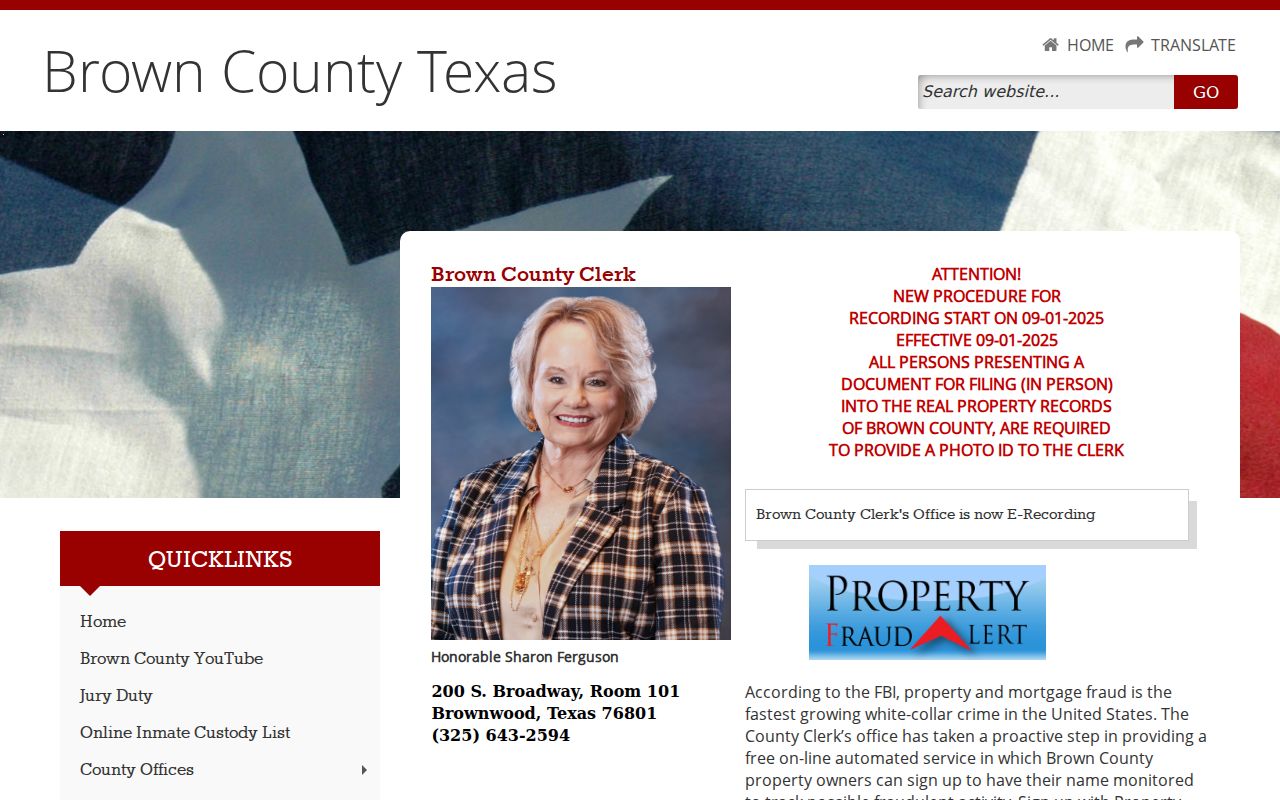
That split prevents a felony request from going to the misdemeanor custodian.
Criminal Case Stages in Brown County
The arresting charge can change before or after a prosecutor files a case. Magistration addresses warnings, counsel, probable cause, and bond. The charging document defines the counts. Pretrial entries may record counsel, motions, discovery, and settings. A plea or trial produces a disposition, and a conviction can proceed to sentencing and later action.
Case flow: Charges Filed → Arraignment → Pretrial → Plea or Trial → Disposition → Sentencing
Read each count separately. Dismissed means the court ended that count without a conviction. Acquitted means a not-guilty result. Deferred adjudication postpones a finding under set terms and is not an acquittal or expunction.
Brown County District Court Stream
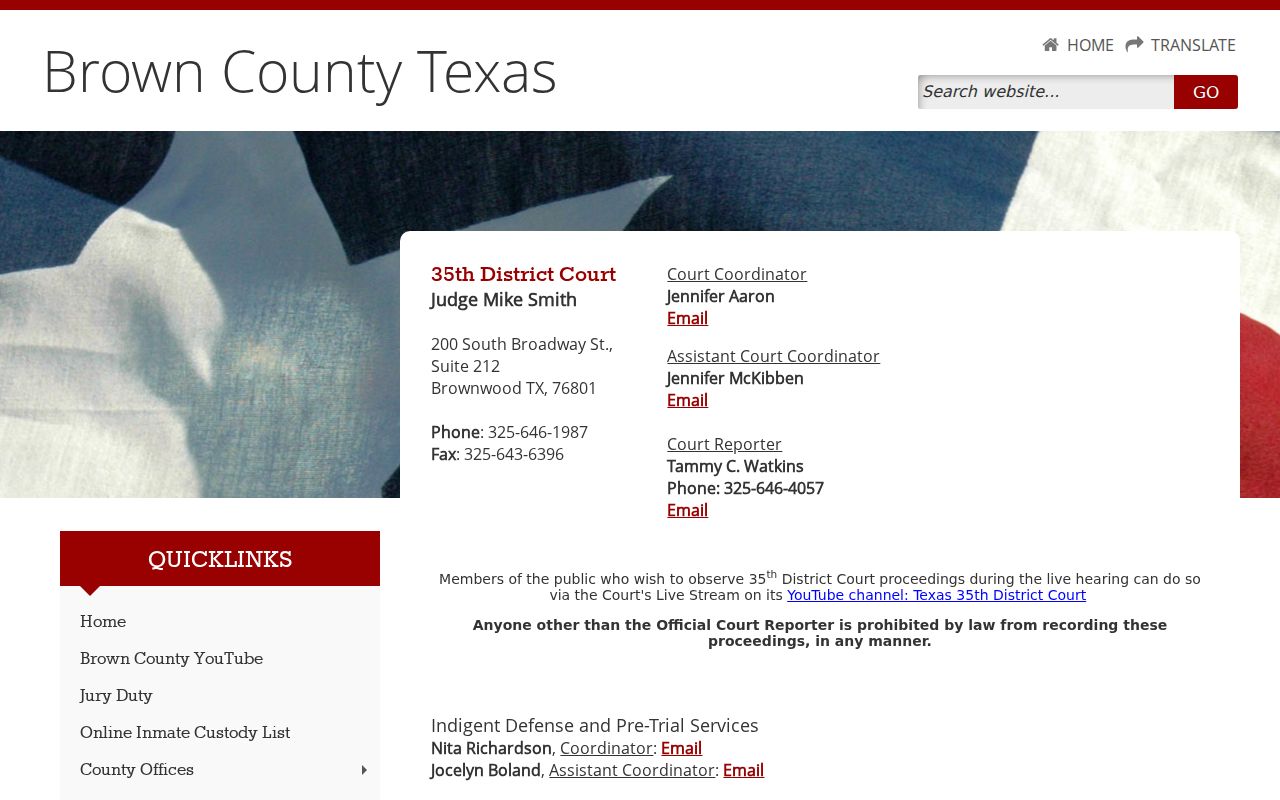
The 35th District Court page provides contacts, a docket calendar, and a public YouTube livestream. Viewing may clarify what occurred in open court, but the stream does not replace an entered order. The court warns that only the official reporter may record proceedings.
The court is in Suite 212 and lists 325-646-1987. Filed-record questions still go to the District Clerk because the judge conducts proceedings while the clerk preserves the papers.
The official source shows the court calendar and recording warning.
A certified order is stronger evidence of a ruling than a remembered stream event.
Brown County Misdemeanor Detour
Since 2003, Class A and B misdemeanors generally go to County Court at Law, except theft-by-check cases filed in constitutional County Court. Felony cases begin in the 35th District Court, though local rules allow some assignments or transfers. A charge label in an arrest report does not predict the final court.
Fine-only Class C allegations remain with a municipal or justice court. Brownwood, Early, and Bangs keep their own city matters. A county felony search can miss a city citation or failure-to-appear case.
Brownwood Municipal Court posts upcoming docket information, but that calendar is not a complete name-based case search. A docket may show a cause number, hearing type, bond, balance, plea, or status at one point in time. Request the actual municipal file when a Class C outcome or warrant-related entry needs confirmation. Early and Bangs likewise retain their own fine-only matters, so county clerk staff cannot certify those city records.
Plain or Certified Brown County Copies
A plain court copy works for reading a Brown County charge, docket event, or result. A certified copy adds the clerk's formal authentication. Ask for certification when a court, licensing body, correction process, or other official recipient requires proof that the document matches the clerk's record.
Name the exact item, such as the judgment, dismissal order, indictment, or docket sheet. That keeps the request focused and may control cost. Confirm the fee and delivery method with the District Clerk or County Clerk before paying. A portal printout is useful for locating the cause, but it is not automatically a certified court record.
For a correction, begin with the source that contains the error. A wrong docket entry belongs with the clerk. A statewide criminal-history cycle belongs with Texas DPS after the supporting disposition is secured. Keep the request, receipt, certified order, and delivery proof together. That trail distinguishes a clerk-file correction from a later repository update.
Access Rules for Case Records
Filed criminal case records are obtained from the clerk under the Texas judicial-record framework. Public files may omit Social Security numbers, full birth dates, account data, protected victim or witness details, minor identities, sealed attachments, and juvenile material.
Online access can be narrower than counter access. When a name returns no result, confirm spelling and aliases, identify the likely court, and ask about older indexes. The District Attorney's password-protected discovery system is only for defense counsel on assigned felony cases, not public search.
Judicial records also differ from police reports. An incident narrative stays with the arresting agency, while pleadings and signed orders stay in the court file. If both are needed, submit separate requests. The public portion can remain available even when protected identifiers or attachments are withheld. Ask whether an archived cause requires advance retrieval.
When the consequence of an error is serious, compare the public docket, the signed judgment or dismissal order, and any later repository entry. A cause number, court name, and certified disposition give Texas DPS a far better correction trail than a screenshot of a name search. Each custodian corrects its own records; the clerk cannot silently rewrite the state repository, and DPS cannot alter the clerk's original file.