
Early Criminal History Checks
Start an Early criminal record search with the event itself. A police report belongs with the city, a Class C matter belongs with the municipal clerk, and a county-level charge belongs with the proper Brown County clerk. The Early Police Department can confirm its request route, but its local check is not a full Texas history. A full personal review follows the fingerprint instructions supplied by Texas DPS.
Use a name, date, location, report number, or citation number when one is known. Precise facts help staff locate a record and separate people who have similar names. Follow this order:
- Ask Early Police for the incident, arrest report, or local check it holds.
- Send a written request through the city coordinator when ordinary counter access does not answer the request.
- Contact Early Municipal Court for a citation, Class C case, or city warrant question.
- Check Brown County custody and clerk channels for charges above the city court level.
- Use DPS name search or fingerprint-based personal review for the distinct statewide layer.
Each source reflects a different stage. A recent arrest may reach the jail before a prosecutor files a case, and a court outcome may appear before DPS receives the final report.
Track Early Police Record Requests
Early accepts public-information requests by email at openrecords@earlytx.net, by mail to City of Early, Attn: Open Records Coordinator, PO Box 3100, Early, TX 76803, and at the counter at 960 Early Boulevard. The counter route is available Monday through Friday, 8:00 a.m. to 5:00 p.m., except holidays. The city logs each request, assigns a tracking number, and routes it to the office that holds the material.
Describe the record, not a question that would require research or legal advice. State that Early Police is the likely custodian. Add the incident date, place, report number, and involved name or role that can lawfully be disclosed. Keep the tracking number and a copy of the request. That paper trail is useful if the city asks for clarification, gives a cost estimate, or seeks a ruling on material it believes may be withheld.
The request channel matters because Early has no single public police-record portal. Email offers a dated submission, while the counter can help a requester confirm that the description is clear. Neither route guarantees release of every page. Active investigative facts, juvenile material, protected identity data, and sensitive victim or witness details can be withheld or redacted.
Records at Early Police
Early Police operates at 960 Early Boulevard and lists 325-646-5322 and fax 325-646-3621. The department creates the first city record for calls, incidents, investigations, and arrests made by its officers. It does not become the custodian of the jail booking merely because an Early officer made the arrest. Ask for the police report from Early, then use county custody sources for the separate booking record.
The official Early Police Department profile shows the local department readers should identify in a request.
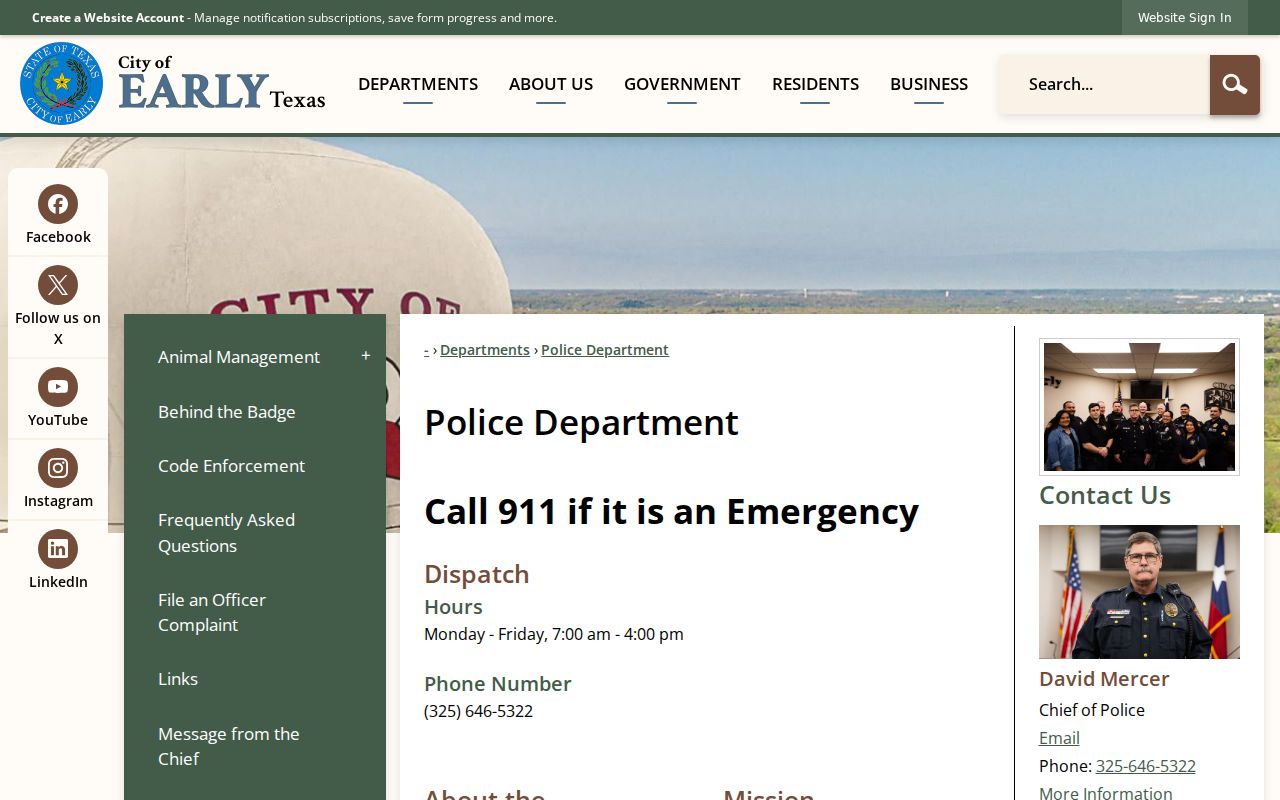
The image anchors the request to the correct city agency rather than a county office with a different file.
Early also offers a local background check when the requester presents current valid identification. It is local only. That means it cannot stand in for a statewide DPS product or a fingerprint-confirmed review of one's own Texas history. Use the local result to answer what Early Police holds, then broaden the search only if the question truly extends beyond the city.
Early Police Ink Fingerprints
Early Police lists an ink-fingerprint service at set time windows. The researched fee is $10 for up to four cards and $3 for each added card. Call the department before traveling to confirm the current window, the identification to bring, and whether the requesting program supplies its own card.
Ink cards are a capture service, not an Early criminal-history result. The agency or program receiving the cards decides how they are used. For a personal review of Texas criminal history, follow DPS fingerprint-service instructions and use the correct service code through IdentoGO. Do not choose a code meant for a different purpose.
Early Police Department
960 Early Blvd.
Early, TX 76802
325-646-5322
Records counter: Monday-Friday, 8:00-5:00, excluding holidays.
The city service and the DPS personal-review route solve different problems. Confirm which one the receiving office or personal-review instruction requires before paying.
Booking and Arrest Records in Early
An Early officer creates the arrest report. Brown County Jail staff create a separate booking file when the person is taken into county custody. No separate Early city-jail page was found in the research. For a recent arrest above Class C, check the official Brown County custody list or call the jail at 325-641-2481, then request the police report from Early.
The two records should not be treated as duplicates. The arrest report focuses on the legal basis, time, place, officer, and alleged offenses. A booking record adds intake identifiers, charges delivered to the jail, bond, and current custody status. Neither proves the allegation led to a conviction. The later filed charge can differ from the arresting charge.
For more county-wide detail, the Brown County arrest search explains the booking and records-request channels. Use Early Police for the city-created report even when the person was booked by the county.
Resolve an Early Warrant Safely
No public Early warrant portal was found. The municipal clerk at 325-339-4757 and Early Police at 325-646-5322 are the local starting points. A county felony capias may instead require the Brown County District Clerk, while a Class A or B misdemeanor may sit with the County Clerk and County Court at Law. A public docket can provide clues, but it does not prove that a warrant remains active.
A February 2025 warrant service in Early led to a standoff that ended without injuries. The local report on that warrant service illustrates why a person should coordinate resolution instead of appearing without a plan.

The event connects a record question to a real safety concern: verify the issuing court and ask what appearance, bond, or payment is required.
When a possible warrant turns up, identify the court, ask about all related holds, and arrange a safe response through counsel, the court, or law enforcement as appropriate. Obtain a written receipt or clearance. Payment alone is not proof that every warrant has cleared.
The Early Municipal Court File
Early Municipal Court shares the police address at 960 Early Boulevard. It hears city ordinance matters, traffic citations, and Class C misdemeanors rather than felony or Class A and B misdemeanor cases. The direct clerk number is 325-339-4757. No public name-based case or warrant portal was found, so access runs through the clerk, an appearance, or a focused records request.
The official Early Municipal Court page gives the local appearance and payment rules.
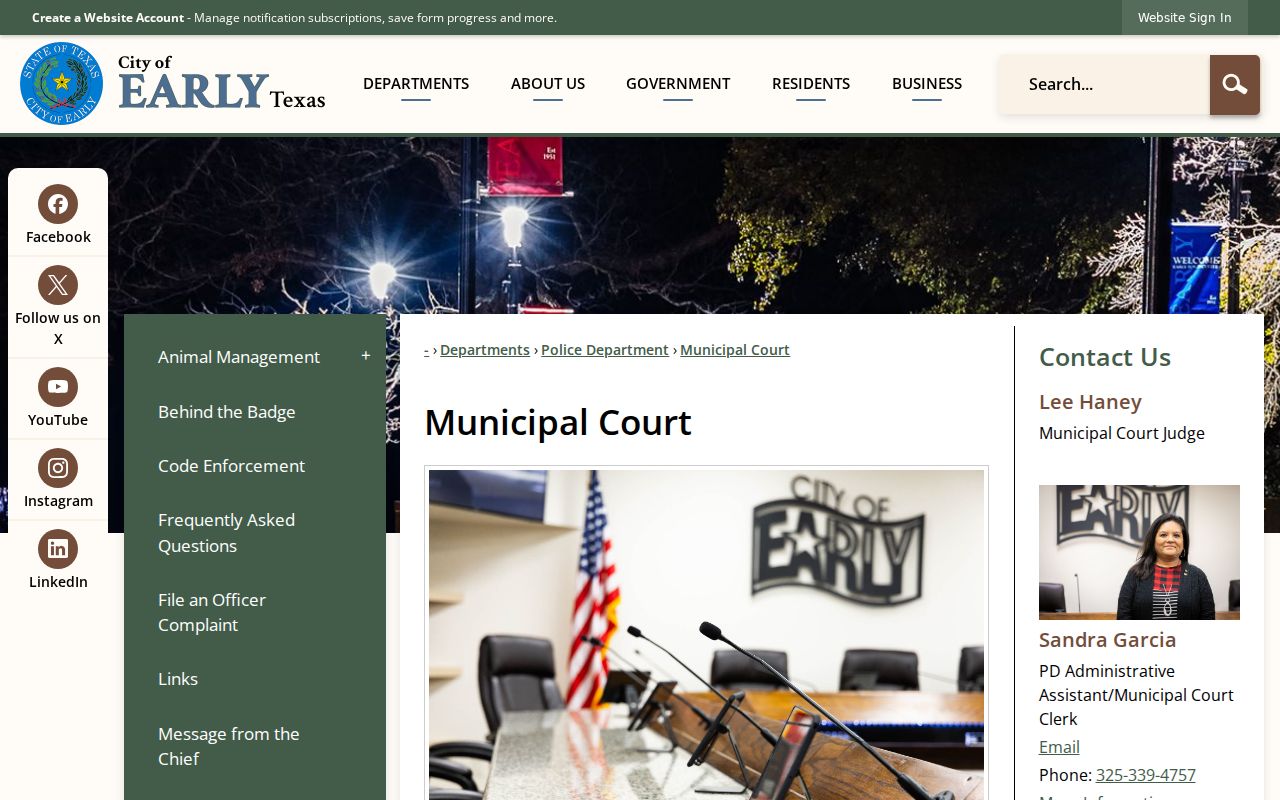
The court source matters because a city citation may never appear in a Brown County felony search.
| Court Name | Early Municipal Court |
|---|---|
| Case Types Heard | City ordinances, traffic matters, and fine-only Class C misdemeanors |
| Case Lookup Channel | Clerk contact, written request, or in-person appearance; no public name portal found |
| What the File Shows | Citation or complaint, settings, plea, judgment, fine, costs, and later court action when public |
| Copies & Fees | Ask the clerk for the current copy charge and accepted request method |
A municipal file answers whether Early filed and resolved a fine-only city case. It does not contain a county felony prosecution merely because the arrest began inside city limits.
Early Court Wednesday Entry Rules
The judge sits Wednesday at 9:00 a.m. Visitors must sign in and be seated before 8:45 a.m.; no appointment is needed. The court permits appearances in person, in writing, or through counsel. Its published rules bar cell phones, food or drinks, shorts, tank tops, and hats. Those details are unusually specific and should be checked before a trip.
Mailed payments must use a money order or cashier's check. The court returns a receipt only when the sender includes a self-addressed stamped envelope. A mailed payment and a request for a file are separate acts, so label each clearly and retain copies. If a warrant or missed appearance is involved, call first and ask what the clerk requires.
Note: Courtroom entry rules and clerk procedures can change, so confirm them by phone before leaving for Early Municipal Court.
How Early Records Reach the County
An Early case can branch at several points. A fine-only city allegation remains with Municipal Court. An arrest that supports a Class A or B misdemeanor moves toward the proper Brown County court. A felony prosecution proceeds through the 35th Judicial District Court and District Clerk. Qualifying arrest and disposition data are then reported to the Texas Department of Public Safety Crime Records Division.
Record flow: Early Police › Brown County Courts › Texas Department of Public Safety Crime Records Division
That line is not instant. A new booking may be visible before a case exists. A dismissal may appear in the clerk's file before DPS receives it. Searchers should compare the city report, county custody file, court disposition, and state result when timing or identity matters.
Early Local Check Versus DPS
The Early local check and the DPS products cover different ground. Early requires current valid identification for its local check and reports only city-held history. DPS offers a public conviction and deferred-adjudication name search, while fingerprint-based personal review is the stronger identity match for one's own Texas record.
| Channel | Coverage | Best Use |
|---|---|---|
| Early Police local check | City of Early records only | Reviewing local police-held information |
| DPS public name search | Public Texas conviction and deferred-adjudication data | Checking the narrower statewide public product |
| DPS personal review | Subject's own fingerprint-linked Texas CHRI | Confirming identity and reviewing one's own repository record |
A no-match result in one row does not erase information held in another. Name searches can also confuse people with similar identifiers, which is why fingerprints provide the stronger personal-review link.
Early Record Access Rules
The Texas Public Information Act governs requests for executive-agency records such as releasable Early Police material. Court files follow clerk and judicial-access rules. DPS criminal-history dissemination is separately limited. Ask the actual custodian and describe the file sought with enough detail for staff to locate it.
Key Statutes:
Texas Government Code Chapter 552 presumes government information public unless law makes it confidential or permits a claimed exception.
Texas Government Code Chapter 411 controls criminal-history dissemination and makes public access narrower than criminal-justice access.
Code of Criminal Procedure Chapter 55A sets the rules for expunction of qualifying arrest records.
Early may redact protected identifiers, juvenile information, sensitive victim or witness details, and active-investigation material. A record missing online is not proof that it was expunged. Request the city file, then verify the court and DPS layers that are relevant to the event.
Read Early Criminal Record Terms
Small wording changes can alter what an Early file means. The arrest label is not always the filed charge, and a booking is not a finding of guilt. These terms help separate stages:
- Booking
- County jail intake created after an arrest and distinct from the Early Police report.
- Disposition
- The court's recorded outcome for a filed charge.
- Class C misdemeanor
- A fine-only Texas offense that may remain in Early Municipal Court.
- Capias
- Court process directing an arrest after a legal or procedural trigger.
- Deferred adjudication
- A disposition that delays a guilt finding while conditions are completed and is not automatically erased.
Read the court outcome by count and date. Do not infer a conviction from an arrest entry or an active warrant from an old docket notation.