
Brown County Sex Offender Checks
The main public channel is the free Texas Public Sex Offender Registry, operated by the Texas Department of Public Safety. It can search by a person's name or by a place in Brown County. The interface also supports an institution or higher-education route and presents results in map or list form. An ordinary public search needs no account, though terms or a CAPTCHA may appear. Search screens change, so use the labels currently displayed instead of relying on an old screenshot.
The Brown County Sheriff supplies the local human follow-up. Call 325-646-5510 to ask about registration, verification, or how to report possible noncompliance. The county has not published separate registration-counter hours, appointment rules, or a registration fee. Confirm those points before visiting the Brown County Law Enforcement Center at 1050 West Commerce, Brownwood, TX 76801. The state portal is the lookup tool; the Sheriff is the proper Brown County contact for local administration.
Start broad enough to catch a spelling variant, then narrow with a middle name, city, ZIP code, county, or address. A profile can list aliases, so one no-match result does not settle identity. If safety depends on the answer, compare the photo and physical description and ask the responsible agency to verify the record. Save the search date and filters because registry details and addresses can change after a Brown County lookup.
Brown County Map or Name
Name and location searches answer different questions. A name search works best when the person is known. It can find an entry even if the registered address is outside Brown County. A place search is better for awareness near a home, school, or other point, but it depends on the address data and radius chosen. Neither route should be read as a complete measure of risk in a neighborhood.
The DPS registry search view shown here is the official starting point for either route.
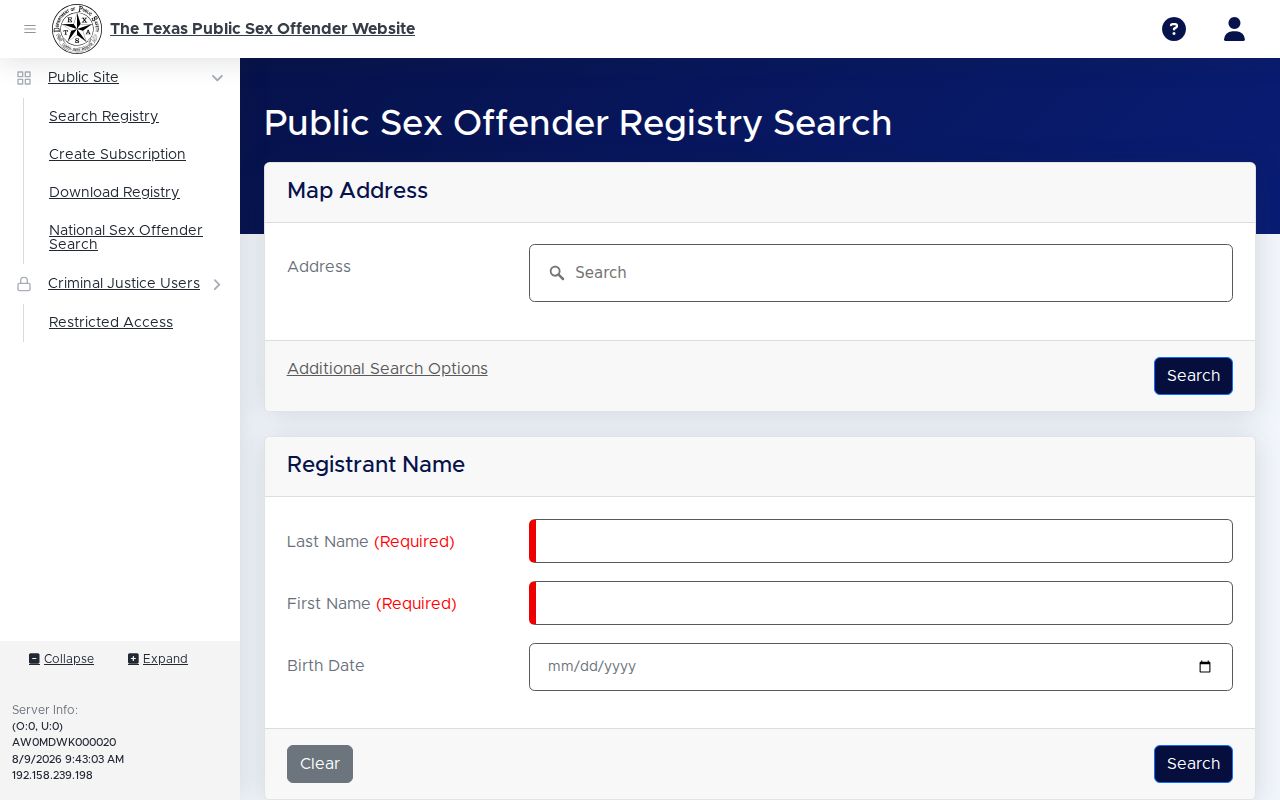
The form helps Brown County searchers move between identity fields and place filters without treating the first result list as final proof.
Texas Public Sex Offender Registry Searches
DPS maintains the statewide source, while Brown County handles local registration duties. Use the official form in a short, repeatable sequence and record the criteria used. That makes it easier to explain a no-match result or ask the Sheriff about an address that seems stale.
- Open the DPS registry, review its current conditions, and choose the name or location route.
- Enter the known name fields, or use an address with Brown County, city, ZIP, and distance filters as the screen permits.
- Review the map or list. Compare aliases and basic identifiers before choosing a profile.
- Open the full profile, read the offense, address, risk, and compliance data, then contact the Sheriff if local verification is needed.
| Field | Type | Required | Use |
|---|---|---|---|
| Last, First, Middle Name | Text | Interface-dependent | Search a known identity; profiles may show aliases. |
| Address | Text | Location route | Enter a valid street address for a place search. |
| City and ZIP Code | Text or filter | Route-dependent | Narrow a Brown County location. |
| County | Filter | Optional | Select Brown for county results. |
| Distance or Radius | Dropdown | Route-dependent | Use the live options; exact choices can change. |
| Search and Clear | Buttons | Not applicable | Run or reset the map/list search. |
Brown County Sheriff Verification
Brown County registration questions go to the Sheriff, not the courthouse clerks or a city municipal court. That division matters when a registry address appears out of date or a profile shows a compliance concern. Supply the profile information and explain the factual issue. Do not confront the person listed or attempt to investigate a residence yourself.
The Sheriff's official page places the office and jail at the Law Enforcement Center. Call before a visit because public research did not verify counter hours or appointment rules for registry work. Staff can explain how Brown County accepts a report of possible noncompliance and what information can be confirmed publicly. An address that looks wrong is a reason to ask, not proof of a violation.
Brown County Sheriff
Law Enforcement Center
1050 W. Commerce
Brownwood, TX 76801
325-646-5510
Note: No verified Brown County registry-alert app was found, so use the official portal and Sheriff's main line.
Registry Profiles: What They Show
A public profile can show enough data to distinguish people while withholding protected identifiers. Texas law supports publication of names and aliases, an available photo, physical traits, residence, reportable offense, registration status, and certain school, vehicle, mark, or tattoo details. The exact fields depend on the record. Brown County users should compare several identifiers rather than relying on a name alone.
| Name and Aliases | Published identity names used to find and distinguish the record. |
|---|---|
| Photo and Description | Available image, sex, race, age or birth data, and physical traits. |
| Registered Address | Residence information released under Chapter 62. |
| Offense | Reportable conviction or adjudication and the listed offense. |
| Risk Information | Numeric low, moderate, or high level when included. |
| Status Details | Registration, compliance, and verification information when shown. |
DPS must withhold Social Security and driver's-license numbers, phone numbers, online identifiers, employer details, and information that identifies a victim. Those omissions are legal protections, not signs that the Brown County registry profile is unfinished.
What Brown County Profiles Hide
The public registry is not the complete file held by law enforcement. Article 62.005 draws a line between safety information and private data. A searcher may see a residence and vehicle details but not an employer's name or address. A photo may be public while the victim's identity remains protected. Telephone numbers and online identifiers also stay out of public view.
The Texas registration statute is the primary source for that boundary.
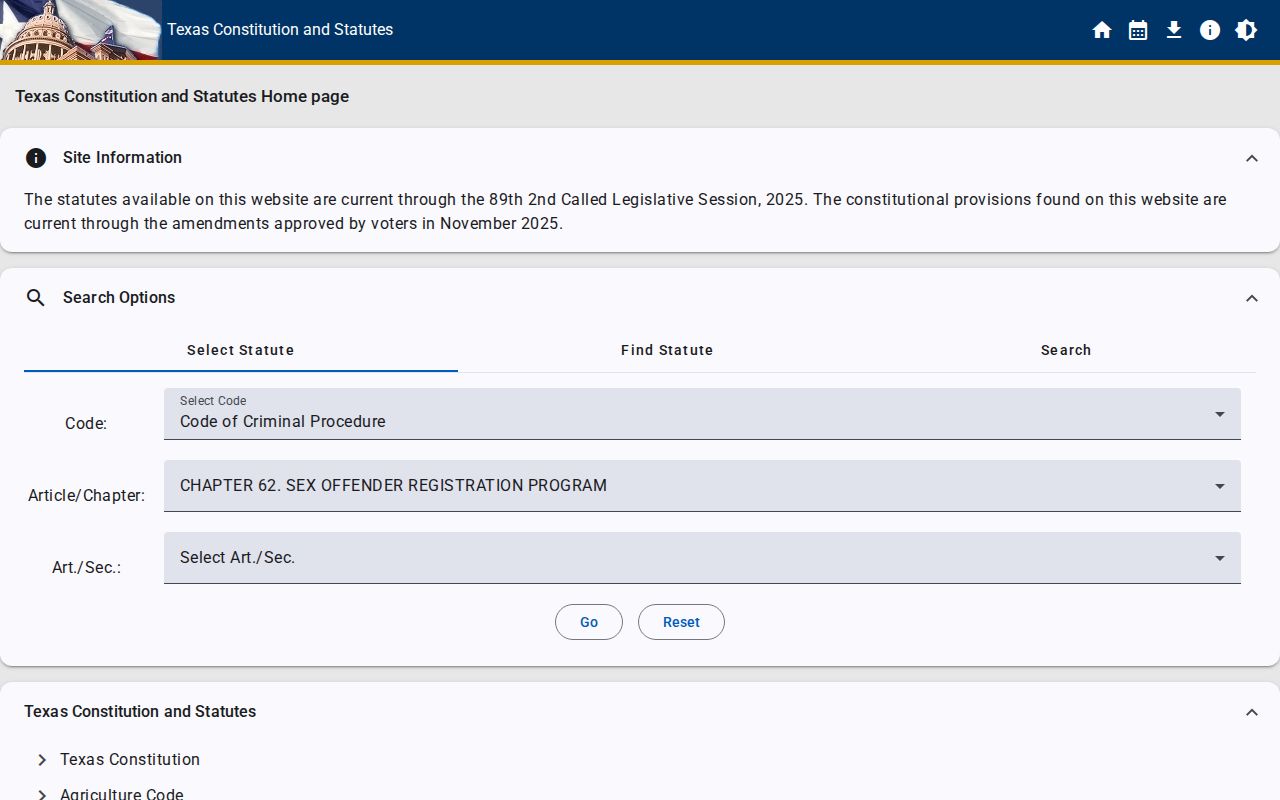
Reading the statute beside a Brown County profile helps explain why some fields are visible and others must remain private.
Registration Levels and Duties in Texas
Texas uses low, moderate, and high numeric risk levels. These are not the federal Tier I, II, and III labels. More important, a Texas registration term turns on the reportable offense and Article 62.101, not directly on the risk label. A low label does not by itself set a short term, and a high label is not a prediction of future conduct.
| Texas Category | General Duration | Verification |
|---|---|---|
| Listed lifetime offense | Lifetime duty under Article 62.101 | Generally annual, with shorter cycles for specified cases |
| Other qualifying adult case | Generally through the tenth anniversary of the latest listed discharge, dismissal, release, or supervision discharge | Generally annual |
| Juvenile adjudication | Generally ten years after disposition or completion, whichever is later, subject to exemption and nonpublic rules | Depends on the governing juvenile order and law |
A person with two or more sexually violent offenses generally verifies every 90 days. A civilly committed sexually violent predator reports every 30 days. Juvenile courts may defer, exempt, or make registration nonpublic under Articles 62.351 through 62.354. Check the current offense-specific DPS chart before drawing a conclusion about duration.
Brown County Verification Cycles
Annual, 90-day, and 30-day reporting cycles describe how often specified registrants must verify information. They do not create three simple public tiers. Brown County carries out local verification within this state framework, while DPS publishes the statewide registry. That split is why an uncertain compliance notation should go to the Sheriff.
Community-notification rules for a high-risk person appear in Article 62.056. Public notices, when issued, are another official channel, but they do not replace the registry search. Keep the date of a search and recheck when circumstances matter. Residence data can change between visits to the portal.
Note: Registration duration, risk level, and verification frequency are separate facts and should be read separately on every Brown County record.
Brown County and National Results
The National Sex Offender Public Website searches participating jurisdictions across state lines. It is useful when a person may have lived outside Texas or when a Brown County address search should be checked against a national layer. NSOPW does not turn federal participation into one new master record. The source jurisdiction still controls its profile and updates.
The national search page offers a clear second channel for a cross-state check.
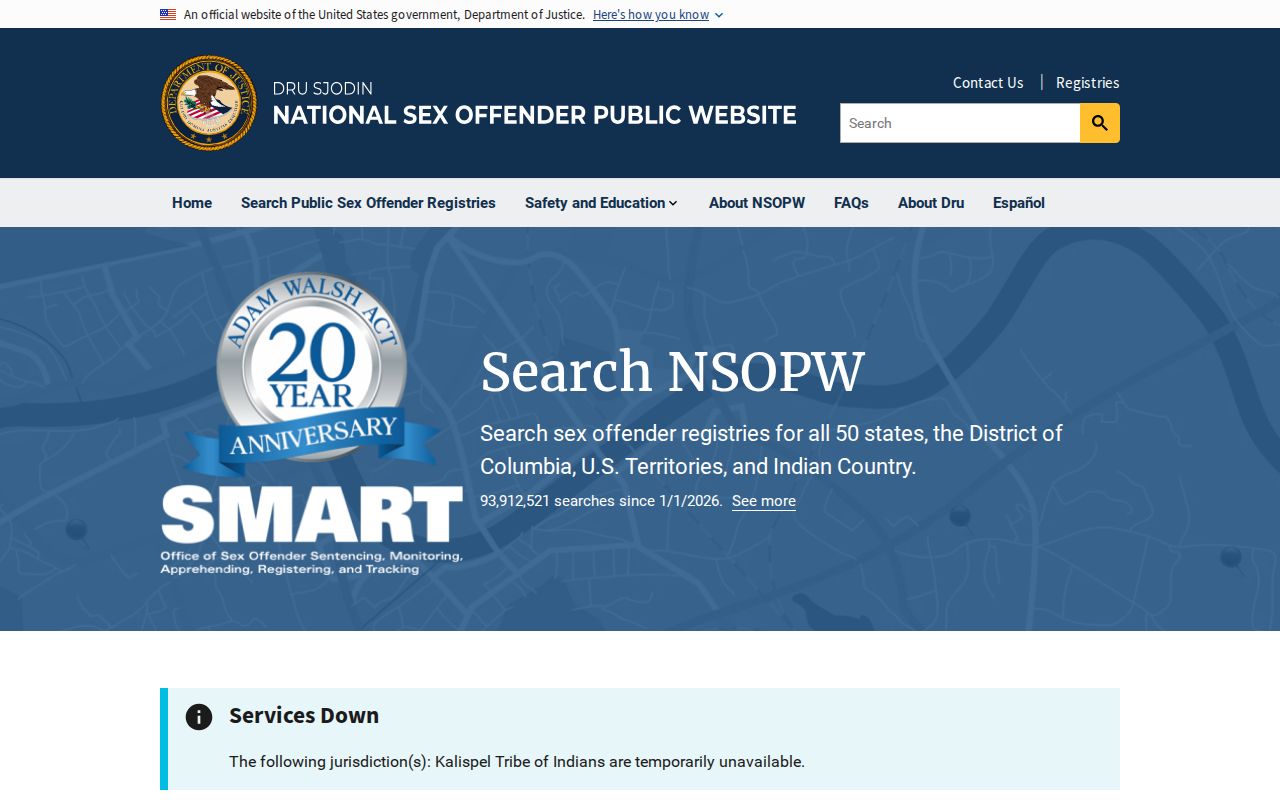
When NSOPW points to Texas data, return to DPS for the full state profile and use the Brown County Sheriff for a local compliance question.
Using Registry Information Lawfully
Registry information is published for awareness and safety planning. Use it to understand official notices, make sound family plans, and identify the correct agency for a factual question. Do not treat a profile as permission to contact, follow, shame, or threaten anyone. Do not publish a private theory about a household member or a nearby address.
Texas Chapter 62 contains the registration and notification rules. Its civil misuse provision is specific, so a broader criminal penalty should not be invented. Other criminal and civil laws can still apply to threats, stalking, intimidation, property damage, or discrimination. Brown County residents should report a genuine compliance concern to the Sheriff and an urgent threat through the proper emergency channel.
Use registry data lawfully: Harassment, threats, vigilantism, and criminal misuse are forbidden. Verify identities and report concerns to the Brown County Sheriff instead of confronting anyone.